
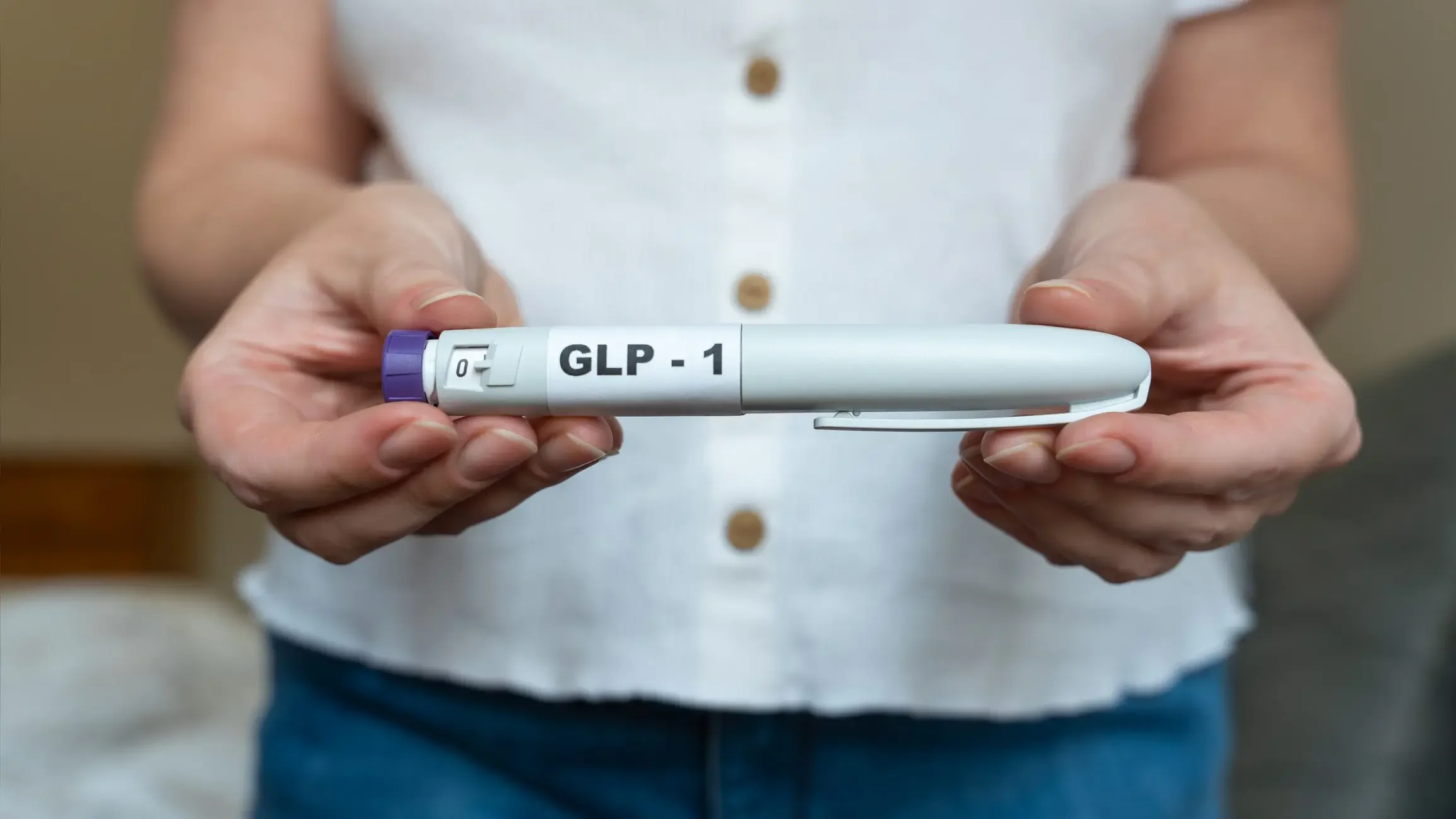
GLP-1 Medications:
What to Know Before You Start
GLP-1 medications are prescription medicines. Each factual statement about them in this article is numbered to a public source listed at the bottom of the page: FDA documents, federal health agencies or peer-reviewed journals.
What GLP-1 is
Glucagon-like peptide-1 (GLP-1) is one of the hormones secreted from the intestine.1 Its effects in the body include stimulating insulin release in a glucose-dependent way, slowing how quickly the stomach empties, and reducing food intake.2 The liraglutide prescribing information states that the body’s own GLP-1 has a half-life of 1.5 to 2 minutes because enzymes break it down.3
MedlinePlus, the National Library of Medicine’s consumer drug reference, places semaglutide in a class of medicines called incretin mimetics. It says semaglutide slows the emptying of the stomach and may decrease appetite and cause weight loss.4 Tirzepatide’s prescribing information describes it as “a GIP receptor and GLP-1 receptor agonist,”5 and the FDA has said it activates the receptors of both intestinal hormones to reduce appetite and food intake.1
Which ones are FDA-approved for weight management
The FDA has approved several medicines in this group for weight management, each for use in combination with a reduced-calorie diet and increased physical activity.3,5,6,7 They include:
| Medicine (generic name) | Form | How often it is taken |
|---|---|---|
| Semaglutide | Injection | Once weekly6 |
| Semaglutide | Tablet | Once daily6 |
| Tirzepatide | Injection | Once weekly1 |
| Liraglutide | Injection | Once daily3 |
| Orforglipron | Tablet | Once daily7 |
FDA records give these approval dates for weight management: semaglutide injection on June 4, 2021;8 tirzepatide on November 8, 2023;1 semaglutide tablets on December 22, 2025;9 and orforglipron on April 1, 2026.7
In March 2024, the FDA approved semaglutide injection to reduce the risk of cardiovascular death, heart attack and stroke in adults with cardiovascular disease and either obesity or overweight.10 In December 2024, it approved tirzepatide for moderate to severe obstructive sleep apnea in adults with obesity.11 The semaglutide injection label also includes the treatment of noncirrhotic metabolic dysfunction-associated steatohepatitis (MASH) with moderate to advanced liver fibrosis in adults, an indication approved under accelerated approval.6
Who they are approved for
The current prescribing information for semaglutide and tirzepatide describes the weight-management population as adults with obesity, or adults with overweight who have at least one weight-related health condition.5,6 Semaglutide injection is also approved for patients aged 12 and older with obesity.6 The tirzepatide label states that its safety and effectiveness have not been established in pediatric patients.5
When the FDA approved semaglutide injection in 2021 and tirzepatide in 2023, it described these groups by body mass index (BMI): 30 or greater, or 27 or greater with at least one weight-related condition.1,8 The National Institute of Diabetes and Digestive and Kidney Diseases (NIDDK) uses the same BMI thresholds when it describes who may be prescribed a weight-management medicine, giving high blood pressure and type 2 diabetes as examples of weight-related health problems.12
The CDC notes limits to BMI. It describes BMI as “a screening measure” that “is not intended to diagnose disease or illness,”13 and states that “BMI does not distinguish between fat, muscle, and bone mass.”14
How the dose is increased
The labels describe starting at a lower dose and increasing it in steps. The semaglutide label says to follow its dose-escalation schedule “to reduce the risk of gastrointestinal adverse reactions.”6 The tirzepatide label sets a starting dose of 2.5 mg once weekly for 4 weeks, and says the dose may be increased in 2.5 mg steps after at least 4 weeks on the current dose.5 For orforglipron, the FDA says treatment starts at 0.8 mg once daily, with dose increases at intervals of at least 30 days.7
The most common side effects
Nausea, diarrhea, vomiting, constipation and abdominal pain appear on the list of the most common adverse reactions, those reported in at least 5% of patients, in the prescribing information for both semaglutide and tirzepatide.5,6 The tirzepatide list also includes dyspepsia (indigestion), injection site reactions and fatigue.5
The boxed warning. The semaglutide and tirzepatide labels both carry a boxed warning about thyroid C-cell tumors. The semaglutide label states that “in rodents, semaglutide causes” thyroid C-cell tumors at clinically relevant exposures, and that it is unknown whether it causes these tumors, including medullary thyroid carcinoma (MTC), in humans.6 The tirzepatide label states that “in rats, tirzepatide causes” thyroid C-cell tumors.5 Both labels list these contraindications: a personal or family history of MTC; Multiple Endocrine Neoplasia syndrome type 2 (MEN 2); and a serious hypersensitivity reaction to the drug or to any of its excipients (inactive ingredients).5,6
Other warnings in the labels
The semaglutide and tirzepatide labels both include warnings and precautions about:5,6
- Acute pancreatitis
- Acute gallbladder disease
- Hypoglycemia (low blood sugar)
- Acute kidney injury due to volume depletion
- Severe gastrointestinal adverse reactions
- Hypersensitivity (allergic) reactions
- Diabetic retinopathy complications in patients with type 2 diabetes
- Pulmonary aspiration during general anesthesia or deep sedation
The semaglutide label also includes a warning about heart rate increase,6 and the tirzepatide label warns that its multi-dose pen must never be shared between patients.5 The semaglutide label’s section on aspiration during anesthesia tells prescribers to instruct patients to inform their health care providers before any planned surgery or procedure if they are taking the medicine.6
The full prescribing information for each of these medicines is published on DailyMed, the National Library of Medicine’s database of drug labels.15
Pregnancy and birth control
The semaglutide and tirzepatide labels both state: “Weight loss offers no benefit to a pregnant patient and may cause fetal harm.”5,6 For patients using it for weight reduction or cardiovascular risk reduction, the semaglutide label says to discontinue it at least 2 months before a planned pregnancy because of semaglutide’s long half-life.6
The tirzepatide label states that it “may reduce the efficacy of oral hormonal contraceptives due to delayed gastric emptying.” It tells prescribers to advise patients who use oral hormonal contraceptives to switch to a non-oral method, or add a barrier method, for 4 weeks after starting tirzepatide and for 4 weeks after each dose increase.5
What studies show after stopping
Semaglutide: the STEP 1 trial extension. This exploratory extension followed a subset of 327 STEP 1 participants, adults without diabetes, for one year after treatment ended. Participants who had taken semaglutide lost an average of 17.3% of their body weight by week 68. After semaglutide and the trial’s lifestyle intervention were both withdrawn, they regained an average of 11.6 percentage points by week 120, for a net loss of 5.6% from where they started. The authors concluded that participants “regained two-thirds of their prior weight loss.”16
Tirzepatide: the SURMOUNT-4 trial. The trial enrolled adults without diabetes. After a 36-week period in which all participants took tirzepatide, 670 participants were randomly assigned to continue it or switch to a placebo. From week 36 to week 88, average weight changed by −5.5% in the group that continued tirzepatide and by +14.0% in the group switched to placebo. The authors concluded that “withdrawing tirzepatide led to substantial regain of lost weight, whereas continued treatment maintained and augmented initial weight reduction.”17
NIDDK’s patient information states: “You probably will regain some weight after you stop taking weight management medication.”12
“Because obesity is a chronic disease, you may need to continue your new eating and physical activity habits and other behaviors for years—or even a lifetime—to improve your health and maintain a healthier weight.”National Institute of Diabetes and Digestive and Kidney Diseases12
Questions to bring to a prescriber
This article covers each of these topics, and each can be raised with a prescriber before starting:
- Which medicine and starting dose are being considered, and how will the dose be increased?
- Which side effects are most common, and which ones should be reported right away?
- Does it interact with any current medicines, including birth control pills?
- Does anything in my personal or family history appear on the label’s list of contraindications?
- What should other doctors be told before a surgery or procedure?
- What happens if the medicine is stopped?
Prestige Weight Loss & Wellness offers medical weight loss in Fort Lauderdale. Patients do not need to join the practice’s concierge membership to use it. Learn about medical weight loss.
Schedule a consultation or call the office at (954) 771-0611.
Frequently asked questions
Are GLP-1 medications FDA-approved for weight loss?
Several are. The FDA has approved semaglutide (as an injection and as a tablet), tirzepatide, liraglutide and orforglipron for weight management, each for use in combination with a reduced-calorie diet and increased physical activity.3,5,6,7
Are there GLP-1 pills for weight loss?
Yes. The FDA approved semaglutide tablets for weight management on December 22, 2025, and orforglipron tablets on April 1, 2026. Both are taken once daily.6,7,9
What happens when someone stops taking a GLP-1 medication?
In the STEP 1 trial extension, an exploratory analysis in adults without diabetes, participants regained two-thirds of their prior weight loss in the year after semaglutide and the trial’s lifestyle intervention were withdrawn.16 In the SURMOUNT-4 trial, also in adults without diabetes, withdrawing tirzepatide led to substantial regain of lost weight.17
Can GLP-1 medications be used during pregnancy?
The semaglutide and tirzepatide labels both state that weight loss offers no benefit to a pregnant patient and may cause fetal harm. For patients using it for weight reduction or cardiovascular risk reduction, the semaglutide label says to discontinue it at least 2 months before a planned pregnancy.5,6
Sources
- U.S. Food and Drug Administration. FDA Approves New Medication for Chronic Weight Management. News release, November 8, 2023. fda.gov
- Müller TD, Finan B, Bloom SR, et al. Glucagon-like peptide 1 (GLP-1). Molecular Metabolism. 2019;30:72–130. PubMed 31767182
- Saxenda (liraglutide) injection. Prescribing information. DailyMed, National Library of Medicine. dailymed.nlm.nih.gov
- MedlinePlus. Semaglutide Injection. National Library of Medicine. medlineplus.gov
- Zepbound (tirzepatide) injection. Prescribing information. DailyMed, National Library of Medicine. dailymed.nlm.nih.gov
- Wegovy (semaglutide) injection and tablets. Prescribing information. DailyMed, National Library of Medicine. dailymed.nlm.nih.gov
- U.S. Food and Drug Administration. FDA Approves First New Molecular Entity Under National Priority Voucher Program. News release on the approval of Foundayo (orforglipron), April 1, 2026. fda.gov
- U.S. Food and Drug Administration. Approval letter, NDA 215256, Wegovy (semaglutide) injection. June 4, 2021. accessdata.fda.gov (PDF)
- U.S. Food and Drug Administration. Approval letter, NDA 218316, Wegovy (semaglutide) tablets. December 22, 2025. accessdata.fda.gov (PDF)
- U.S. Food and Drug Administration. FDA Approves First Treatment to Reduce Risk of Serious Heart Problems Specifically in Adults with Obesity or Overweight. News release, March 8, 2024. fda.gov
- U.S. Food and Drug Administration. FDA Approves First Medication for Obstructive Sleep Apnea. News release, December 20, 2024. fda.gov
- National Institute of Diabetes and Digestive and Kidney Diseases. Prescription Medications to Treat Overweight & Obesity. Last reviewed June 2024. niddk.nih.gov
- Centers for Disease Control and Prevention. Adult BMI Calculator. cdc.gov
- Centers for Disease Control and Prevention. About Body Mass Index (BMI). cdc.gov
- DailyMed. National Library of Medicine. dailymed.nlm.nih.gov
- Wilding JPH, Batterham RL, Davies M, et al. Weight regain and cardiometabolic effects after withdrawal of semaglutide: the STEP 1 trial extension. Diabetes, Obesity and Metabolism. 2022;24(8):1553–1564. doi:10.1111/dom.14725. doi.org
- Aronne LJ, Sattar N, Horn DB, et al. Continued treatment with tirzepatide for maintenance of weight reduction in adults with obesity: the SURMOUNT-4 randomized clinical trial. JAMA. 2024;331(1):38–48. PubMed 38078870
This article is for general information only and is not medical advice. It does not replace a conversation with a licensed health care professional about your own health. Do not start, stop or change a prescribed medication without talking to your prescriber. In an emergency, call 911.